
Junwoo
2026-06-19 09:34:40
Behind
Before you get a quote for one AI video, ask yourself this: "How many times will I want to repeat this?"
🎓
Automating shorts is easy—getting them consistently great every time is the real challenge
If you search for shorts automation, you’ll find endless workflow tutorials that promise everything at once: script generation, images, voiceover, even upload. ...

🎓
Before You Pick an AI Video Editor, Decide *What* You Actually Want to Make
When you read those “Top 5 AI video makers” listicles, they usually bundle all the trendy tools together, compare pros and cons, and highlight key features.But ...
🤔
Before you get a quote for one AI video, ask yourself this: "How many times will I want to repeat this?"
The first message we usually get from people asking about AI video outsourcing is almost always the same. It all boils down to one question: “How much is it?” I...
📣
How a Franchise Café Automated Its Digital Signage Videos (and Saved a Lot of Time)
Running Videostew has given us a front-row seat to the challenges faced by potential customers across all kinds of industries.And there’s one topic that always ...

📣
How We Turned a Pile of Blog Posts into a Flood of Shorts: Automation for Speed, Humans for Quality!
This is a story from one of our VX service clients—a hotel based in Yeoju that runs a blog to promote their property.They had already published over 200 blog po...
🗞️
[Update] Instantly generate multiple slides with AI right from the slide editor ✨
You can now generate AI content for multiple slides directly in the Videostew editor. Just pick the element you’re editing, choose whether you want an image, vi...
![[Update] Instantly generate multiple slides with AI right from the slide editor ✨](https://cdn.videostew.com/files/thumb/f72020c7f-7vp6h1rc0)
🎓
These days, I’m running Videostew with a little help from Claude Code
Recently, we landed a pretty big gig with our VX production service. To celebrate the opening of the Manhae Museum, we’re creating a full digital video archive ...
🎓
AI Video Creation Isn’t a Tool Problem: Where Creators Actually Get Stuck (and How to Break Through)
By the time you’ve landed on this post, you’ve probably read your fair share of “Top AI Video Tools” articles. You’ve seen everything from clip-generation servi...
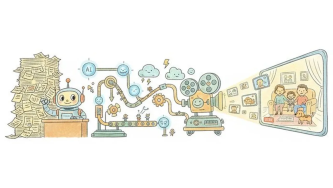

The first message we usually get from people asking about AI video outsourcing is almost always the same. It all boils down to one question: “How much is it?” If you’re even considering AI videos, chances are you’re not just looking for a one-off video.
In the end, someone who wants a single promotional video and someone who needs dozens of videos every month should be choosing completely different types of providers. But when you Google “AI video production company,” it’s almost impossible to tell who does what, so you end up sending inquiries everywhere and hoping for the best.
That’s why today we’re going to show you exactly how we actually work. No fancy buzzwords—just a clear breakdown of what the machines handle and where humans step in, stage by stage.
AI video outsourcing: every provider is selling something different
The AI video market generally falls into three big categories: tools you use yourself, studios that craft a single high-quality video, and services that mass-produce videos in the same format. They sound similar, but what they actually do is very different.
What shows up first in search results is usually AI video generation “tools.” These are SaaS platforms that turn text or avatars into video. They’re not really “outsourcing”—you still have to roll up your sleeves and make the videos yourself.
The second type is traditional video production companies that have added AI into their workflow. You’ll see claims like “30–40% labor cost reduction, delivery in 3 days.” They do great work. But each video is treated as a separate project, which means higher pricing and a process that’s too heavy to repeat every week.
Our service, Videostew VX, is much closer to the third category. We don’t aim to make one video that belongs in a museum. We focus on helping you consistently produce videos in the same structure—week after week, month after month.
"If you’re thinking, ‘Our blog posts or articles pile up every day, and we need to keep turning them into videos’—that’s exactly what we’re built for."
If your company generates tons of text, your outsourcing strategy should look different
High-volume video outsourcing works best for companies that constantly produce text. Think news articles, press releases, columns—places where fresh writing shows up every single day.
Just look at our current customers and it becomes obvious. One media company that publishes a business magazine turns their weekly cover stories and feature articles into videos. Before, their team had to manually create every single video using CapCut plus a mix of AI tools. Now, they simply send us the weekly PDF and automatically receive videos with consistent quality—week after week.
Another media outlet running a YouTube channel for seniors uploads Shorts created from both card-news-style articles and regular articles. They originally edited everything themselves in the Videostew SaaS, but as the volume of articles grew, they couldn’t keep up—so they asked us to handle large-scale video production as an outsourced partner.
All these customers share one simple thing: they already have a huge amount of “raw material (text)” inside the company that deserves to be shown as video.
To be honest, the most important factor is the quality of the original text. If the source content is valuable, you can scale it into lots of videos and that value still carries through. On the other hand, if the original text is weak, no amount of pretty visuals can fully fix that. That’s why, when we get a new outsourcing request, the first thing we look at is: “What kind of writing does this company produce?”
If this sounds like you, then starting a video just by dropping in the article URL is usually a perfect fit. Share a single link, and we pull in the text and images to automatically build the backbone of your video. If you’re in news or media, take a look at our Automated Video for Media Companies page first—it’ll quickly give you the full picture.
Where does automation end, and humans begin?
We often get asked, “So… does AI do everything for you?” Not yet. One day, maybe. And when that day comes, the cost will probably be even lower. 😉
For now, we generate a large batch of content in one go with automation, but we always have humans review and add the final touches.
Here’s how it works in more detail. We tell an agent (like Claude Code), “Create videos from these articles,” and the agent pulls the text into Videostew, splits it into slides, adjusts the script to fit the length, adds narration using AI voice, and places images. It prioritizes images from the original article, and where those are missing, it generates AI images or AI videos to complete the first draft.
Then humans step in. Early on, we watch each rendered video one by one. If a certain word is consistently mispronounced (this happens a lot with proper nouns) or a completely irrelevant image sneaks in, we step back and design how to refine the user dictionary and overall rules.
Sometimes the agent gets a little too creative and quietly rewrites the script against the original guideline. Spotting and correcting that is exactly where humans shine. If automation gets you to 90, humans fill in the remaining 10. And that last 10% is what shapes how the video actually feels.
Why you should think in cost per minute, not cost per video
For AI-based, repeatable video production, it makes much more sense to calculate cost “per minute” rather than “per video.” Even if two outputs are each a single video, the actual production cost going into them can be very different.
The baseline rate for Videostew VX starts at 7,000 KRW per minute. The final cost can go a bit up or down depending on how many AI-generated images you use, but as a rule of thumb, you can think of a 1-minute news-style video that performs reasonably well on YouTube and other platforms as being around 7,000 KRW.
If you’re used to thinking of video production as something that costs a few million won per piece, that price point may feel almost suspiciously low. The reason this pricing structure is possible is that we build everything on top of Videostew, which allows us to automate the video production process to an almost ridiculous degree. Once we set up the right templates and guidelines, it’s basically a “swap in new ingredients” system to get a finished video.
And this isn’t just theory—this is how things already work in practice. Whether you use the Videostew API directly or ask us to handle the production for you, the underlying automation system is the same. Several major news outlets in Korea are already running their video production on this system.
One client uploads around 80 news videos to YouTube every month. Another converts 3–5 articles into videos every single day. Because everything is automation-based, they don’t need a dedicated in-house video team.
If they had outsourced every single video the traditional way, the unit cost would skyrocket—and the turnaround time just wouldn’t keep up. If you’re running your own channel and trying to figure out how to plan your monthly video output, you might find this article useful: a guide that breaks down different types of free stock video sites.
So, should you do it yourself or hand it off?
To be completely honest: you can absolutely do all of this yourself. These days, it’s totally feasible to hook into an LLM via API, generate voiceovers, design your visuals, and assemble the final video on your own. You could even do it without using Videostew.
Here’s the part you only really understand once you try it yourself: it almost never works the way you want on the first attempt. You tweak the prompt dozens of times, don’t like the result, start over from scratch… and repeat.
If you’re running a personal YouTube channel just to share information, you can probably live with that level of randomness. But from a company’s perspective, that unpredictability is a serious risk.
You want to raise your content quality, but it feels awkward to hire a whole new person just for this? That’s exactly when you can hand it off to us.
Getting started is much lighter than you’d think. Just send us a few article links every week, or even a single PDF. That’s enough.
From there, we run everything through our automation pipeline, then have real humans review it and turn it into finished videos. Early on, we go through a style-alignment phase: you watch the outputs, send us feedback, and we keep refining the templates and guidelines. Over time, the whole thing settles into a system that runs automatically—without you needing to communicate with us every time.
If you’re curious how this works in practice, take a look at our VX video outsourcing case studies. And if you’d like to try it yourself, head over to Videostew and spin up your first video—no heavy commitment required.
FAQ
Q. How much does it cost to outsource AI video production per video?
At VX, pricing is based on minutes, not per video. It starts at 7,000 KRW per minute, and can go up a bit for contracts that require heavy AI video usage. For example, a 1-minute news-style video will typically be around 7,000 KRW. If you’re planning a single, high-end cinematic ad, a traditional production studio may actually be a better fit. Our recommendation: decide based on this question — “Will we need to produce this type of video repeatedly?”
Q. If AI makes the video, won’t the quality suffer?
We use automation to build the backbone, then humans step in for the details: pronunciation fixes, image layout, and catching any awkward context. Early on, we also carefully watch the rendered videos to spot frequent errors and feed them into our dictionary. So it’s not 100% unmanned — think of it as AI doing the first 90%, and humans polishing the final 10%.
Q. Can our company’s content be turned into videos too?
If you regularly publish text content — articles, press releases, columns — you’re a great match. You already have the raw material for video inside your organization. On the other hand, if you rarely produce text that’s worth turning into video, the benefits of recurring AI-based production might be limited.
Q. What do we need to get started?
No grand preparation needed. A simple list of article URLs or a single PDF is more than enough. From there, we handle script refinement, narration, and image placement — and after your review, we deliver finished videos.